Auburn faces Lewiston across the Androscoggin River, and the two cities share more than a bridge. They share a mill era, a housing era, and the pipe materials that came with it. Auburn's streets hold mill-worker homes, downtown blocks, and lakeside neighborhoods, and under those streets run clay and cast iron laterals that have aged the same way Lewiston's have: joints opening, roots entering, and iron thinning from the inside.
Auburn Shares Lewiston's River and Its Pipe History
We work Auburn with the same rule we apply everywhere: the camera goes in before any method is chosen. An Auburn homeowner who calls about a slow drain gets footage first, because a slow drain can mean a root mass at one joint, a sagging section, or a grease and scale buildup in a line that is otherwise sound, and each of those calls for a different tool.
Auburn Neighborhoods, ZIP Codes & Map
The ZIP codes and neighborhoods below are the Auburn areas we serve on public sewer. Tell us the neighborhood or ZIP code when you call, and the visit starts from the right part of the city.
ZIP codes we serve in Auburn:
ZIP code
Coverage
04210
Standard street-delivery ZIP
Post-office-box ZIPs for Auburn are not listed, because they do not cover street addresses.
Neighborhoods we serve in Auburn:
New AuburnDanvilleEast AuburnNorth AuburnLittlefield CornerMarston Corner
The map below centers on Auburn, Maine. Homes on public sewer in the neighborhoods above are within our service area. If a property sits near Lake Auburn or across the river from Lewiston, mention that when you call, since ground and layout can shape the inspection.
Primary ZIP: 04210. Our office address is 400 Congress St, Portland, ME 04101, United States, and you can reach us at (207) 819-0831 or [email protected].
Auburn Neighborhoods, From New Auburn to the Lake
New Auburn and downtown Auburn hold the city's oldest and densest housing, where laterals are short and street trees stand close to the line. East Auburn and the Court Street and Minot Avenue corridors stretch that pattern into mid-century streets, while Danville and the Taylor Pond area bring longer lots and more yard between the house and the main. The Lake Auburn area adds a waterside setting, where damp ground and seasonal movement work on joints the same way coastal soil does elsewhere in Maine.
Neighborhoods and areas we cover in Auburn include New Auburn, Downtown Auburn, Lake Auburn area, Danville, East Auburn, Taylor Pond area, Court Street, Minot Avenue.
Lake Auburn itself is the landmark most Auburn residents point to first, and the Androscoggin River is the second, marking the twin-city boundary. Between the lake and the river sits a housing stock that spans the mill era to the present, and no single pipe story covers it all. The City of Auburn site publishes city information for residents who want to learn more about local services.
What Auburn Homeowners Notice First
Whole-house slow drains point to the main line, while a single slow sink usually points to that fixture's trap. Gurgling across fixtures, backups that return after clearing, and a sewage smell near a floor drain are the main-line signs we take seriously in Auburn. A smell that appears only in one bathroom, by contrast, may be a dry trap or a vent issue, and we check traps and vents before recommending line work.
We also listen for timing in Auburn calls. A backup that follows heavy rain may involve the street system as well as the house lateral, while a backup that happens in dry weather points more directly at the house line itself. Both deserve a camera look, but the timing helps us decide where to start the run and what to watch for in the footage.
Auburn clay joints fail the way clay joints fail everywhere: the seal gives way, moisture escapes, roots follow, and the joint opens wider with each season. Cast iron corrodes along its bottom, catches waste on rough scale, and narrows until a backup becomes routine. The two materials often meet in one lateral, where an old clay run was joined to a cast iron section decades ago, and the joint between materials becomes the weakest point of all.
The symptom chain in Auburn usually starts quietly. A tub drains slower than it did last year, a toilet gurgles when the laundry runs, or a basement drain backs up once and then stays clear for a month. Those quiet signs are easy to dismiss, and they are also the most useful, because they appear while the failure is still a joint or a section, not a collapsed run. A camera check at that stage often saves a homeowner a much larger repair later.
How an Auburn Inspection Turns Into a Repair
Our Auburn visits follow a short, visible sequence. Nothing is buried, lined, or replaced on a guess, and you see the footage that supports the recommendation.
We record the symptom pattern and locate the cleanout, then run the push camera toward the main.
We mark the depth and location of each joint failure, root mass, sag, or material change on the footage.
We explain the footage in plain words and compare the repair options that fit it, including bursting where a full run has failed.
We carry out the repair and re-camera the finished line, so the result is visible on screen.
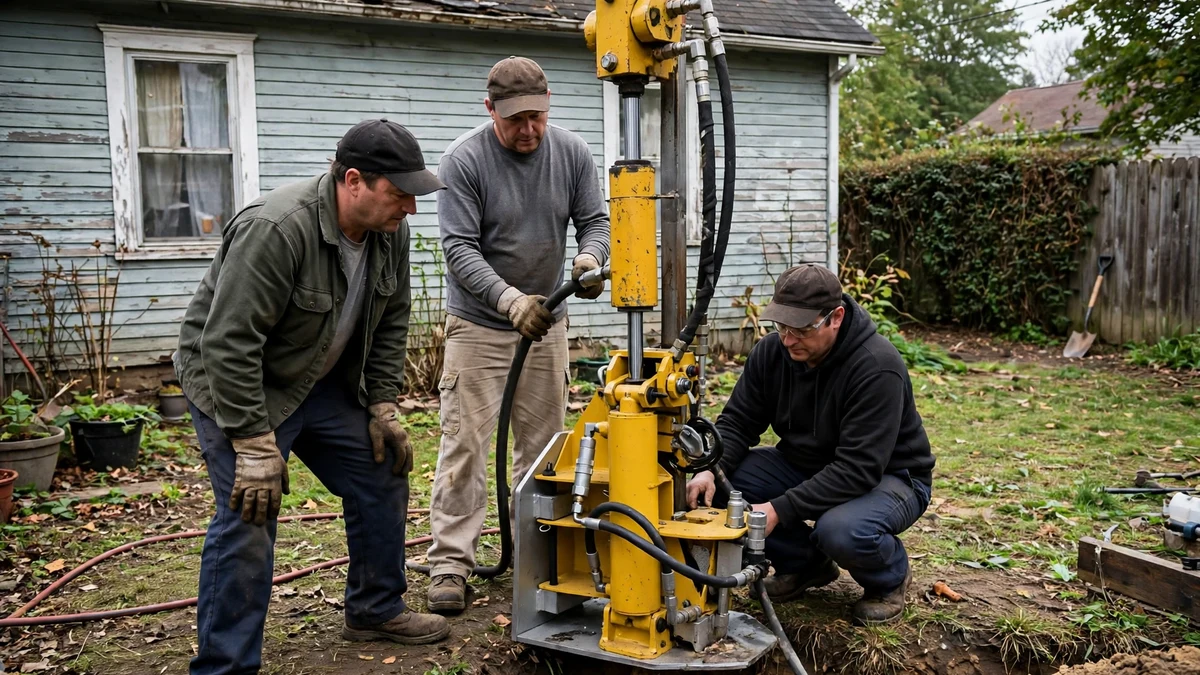
Auburn is a good place for pipe bursting, because many failed laterals run under yards and driveways where a full trench would be disruptive. Bursting suits a run that has failed along its length but still holds a path for the new pipe. When the old pipe has collapsed flat or the path is blocked, excavation is still the honest choice, and the camera tells us which case we are in.
Auburn Winters Move Old Joints
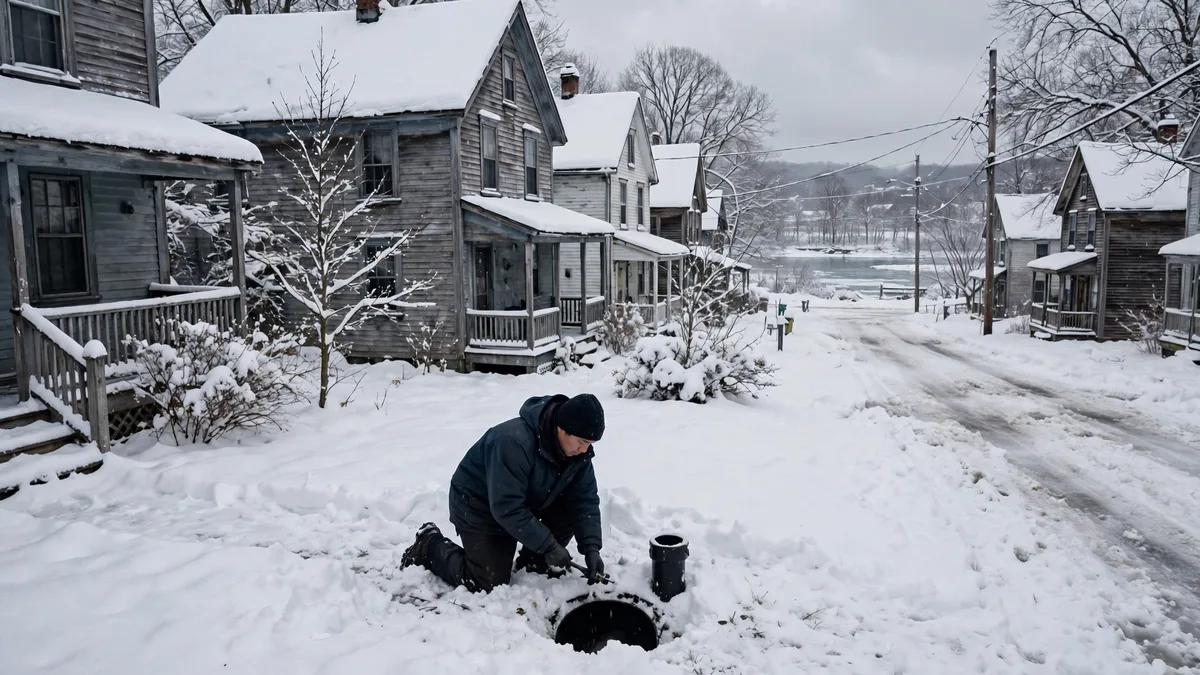
Maine frost depth commonly reaches 4 to 5 feet or more, and Auburn's winters work on buried pipe through the same freeze and thaw cycle as the rest of the state. Shallow ground moves the most, and old clay joints feel that movement first. A joint that survived one winter may not survive the next, which is why Auburn lines often show a slow decline across several winters rather than a sudden failure.
Lake-side ground in the Lake Auburn area stays damp longer into autumn, and damp soil heaves harder when it freezes. That does not mean lakeside homes are doomed to sewer trouble, but it does mean a slow drain near the lake deserves a camera check sooner rather than later. Early footage gives a homeowner a plan, while a winter backup gives only an urgent problem.
Sewer Services for Auburn Properties
Auburn's twin-city housing and lakeside streets need the full service range, from camera checks in New Auburn to bursting under a Danville yard. Each card below carries an Auburn note. The twin city old pipe failure pattern is one we watch for here, and all work follows the Maine plumbing code and the Auburn sewer ordinance.
When a line breaks or sewage backs up and the house cannot wait, we stop the damage first and then trace the failure with a camera. That twin-city pattern shows up across Auburn, where mill-era homes and lakeside streets share old laterals.
We run a push camera through the line and watch the footage with you, so the repair decision rests on what the pipe actually shows. In Auburn we see this from New Auburn and downtown out to Danville and the Taylor Pond area.
Where the host pipe still holds its shape, we form a new pipe inside the old one through small access points, without a full trench. For an Auburn home, the footage decides the method, especially where a yard or driveway sits over the line.
We pull a new HDPE pipe through the path of a failed line, breaking the old pipe outward as the new one takes its place. That twin-city pattern shows up across Auburn, where mill-era homes and lakeside streets share old laterals.
When a line has collapsed or lost its grade, we open a trench, set the new pipe at the right fall, and backfill it properly. In Auburn we see this from New Auburn and downtown out to Danville and the Taylor Pond area.
When the camera shows one bad joint or one cracked section, we fix that section only and leave the sound pipe alone. For an Auburn home, the footage decides the method, especially where a yard or driveway sits over the line.
We replace the house-to-street segment when it has failed along its length, connecting the home cleanly to the main. That twin-city pattern shows up across Auburn, where mill-era homes and lakeside streets share old laterals.
We scour grease, scale, and sludge from the pipe wall with high pressure water, restoring flow in a line that is still sound. In Auburn we see this from New Auburn and downtown out to Danville and the Taylor Pond area.
We clear a blockage mechanically with a snake and cutter head, then check with a camera to see why it blocked. For an Auburn home, the footage decides the method, especially where a yard or driveway sits over the line.
We cut roots out of the line at the joints where they entered, then camera-check the joint to judge what comes next. That twin-city pattern shows up across Auburn, where mill-era homes and lakeside streets share old laterals.
We replace clay, cast iron, and Orangeburg runs that have reached the end of their working life with modern pipe. In Auburn we see this from New Auburn and downtown out to Danville and the Taylor Pond area.
Where a pipe still has its strength but seeps at joints or pinholes, we coat its inside to seal it without replacing it. For an Auburn home, the footage decides the method, especially where a yard or driveway sits over the line.
We inspect on a planned schedule, grade the condition over time, and catch joint wear or root regrowth while it is still small. That twin-city pattern shows up across Auburn, where mill-era homes and lakeside streets share old laterals.
We fit a valve that closes when the street main surges, so a surge stops at the valve instead of coming up through the house drains. In Auburn we see this from New Auburn and downtown out to Danville and the Taylor Pond area.
We trace a sewer smell to its source, checking traps, vents, seals, and the line itself with a camera before we recommend a fix. For an Auburn home, the footage decides the method, especially where a yard or driveway sits over the line.
We handle shops, offices, and larger buildings, where high use and grease put a different load on the line than a house does. That twin-city pattern shows up across Auburn, where mill-era homes and lakeside streets share old laterals.
Call or email about an Auburn property, and tell us the neighborhood and the symptom pattern. Both shape the visit.
Auburn Repair Options, Compared Side by Side
An Auburn repair is chosen from footage, not from a rule of thumb. This table shows the reasoning behind each method.
Method
When it fits
What it avoids
Camera inspection
When the symptom could come from several causes
Guessing the repair from the symptom alone
Spot repair
When one section is bad and the rest of the run is sound
Replacing pipe that still has life in it
Trenchless lining
When the pipe keeps its shape but its joints or surface have worn
A trench through a finished yard
Full replacement
When the run has collapsed or sagged out of grade
Another clearing on a line past repair
How an Auburn Repair Is Chosen, Step by Step
The sequence is short on purpose: see the pipe, show the footage, then choose the smallest repair that fits what was found.
Walk the property and talk through the symptoms, then find the cleanout and set up the camera.
Run the camera through the lateral to the main and record the full run.
Show the footage and explain it in plain words: which joints or sections are involved, and what each one means.
Recommend the smallest repair that fits the footage, and carry it out.
Frequently Asked Questions About Auburn Sewer Lines
Is Auburn sewer work the same as Lewiston sewer work?
The pipe history is similar, since both are mill cities, but each lateral is its own case. We camera every Auburn line separately and never assume it matches a Lewiston neighbor.
When does pipe bursting make sense in Auburn?
Bursting fits a run that has failed along its length but still holds a path, especially under a yard or driveway. A collapsed or blocked path needs excavation instead, and the camera decides.
Why do Auburn lakeside homes see sewer trouble?
Damp ground near the lake moves more with freeze and thaw, which works on old joints. That does not guarantee trouble, but it makes a slow drain near the lake worth a camera check.
Do you serve New Auburn and Danville?
Yes. We serve New Auburn, downtown Auburn, the Lake Auburn area, Danville, East Auburn, the Taylor Pond area, Court Street, and Minot Avenue.
Can a camera inspection find a joint failure between materials?
Yes. A clay-to-cast-iron joint often shows clearly on footage, since the materials look different and the joint is a common failure point.
What if my Auburn line has both clay and cast iron?
That is common in mill-era homes. We grade each section on its own footage and repair the failing sections, rather than replacing a sound section just because its neighbor failed.
Start With a Camera Look at Your Auburn Line
Tell us the neighborhood, the house age if you know it, and what the drains have been doing. We will inspect with a camera and explain the footage before any repair is discussed. In Auburn, that camera-first start is how every job begins.