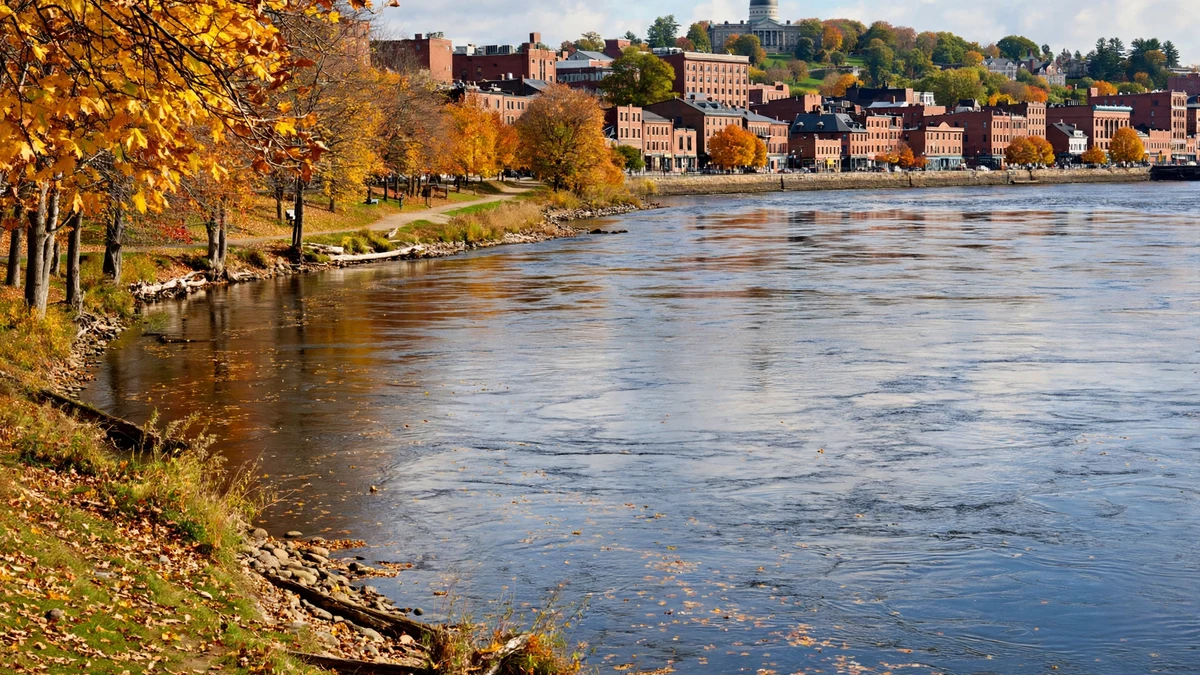
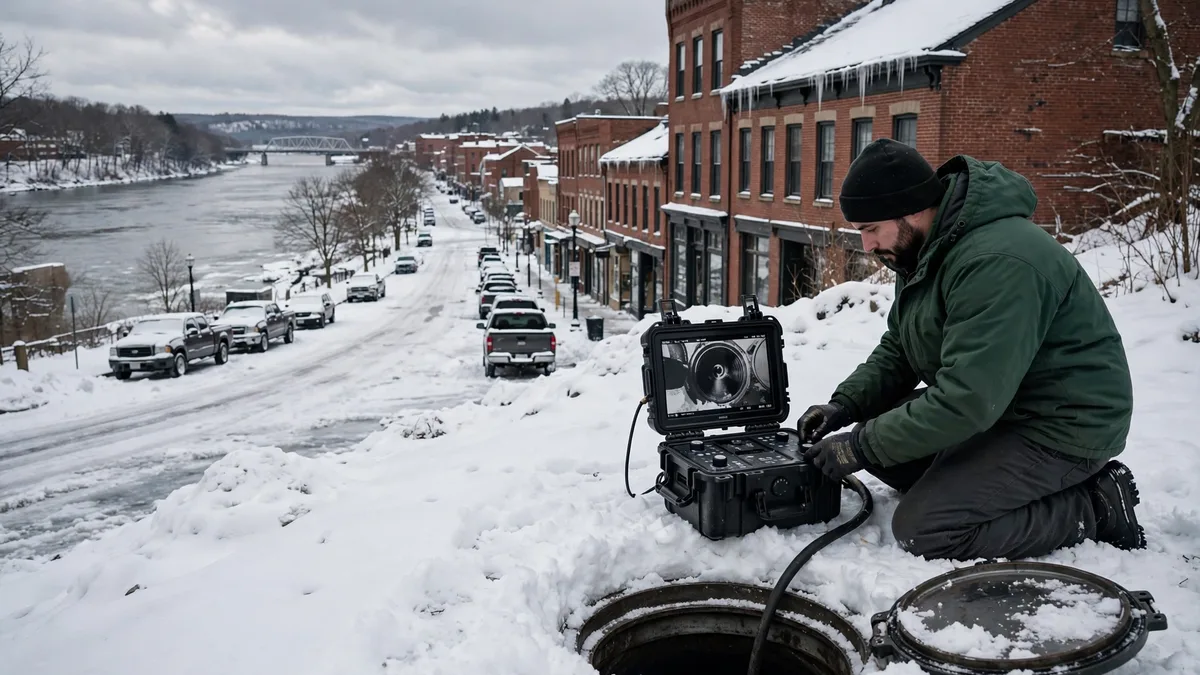
Augusta serves as Maine's capital, and its sewer story starts with that role. The downtown core and the streets around the State House hold older homes and buildings, with laterals from the clay and cast iron eras, while Western Avenue, Eastern Avenue, and the outlying corridors add newer streets to the mix. The Kennebec River runs through the middle of it all, and river valley ground shapes the pipe story in the same way it does in other river cities.
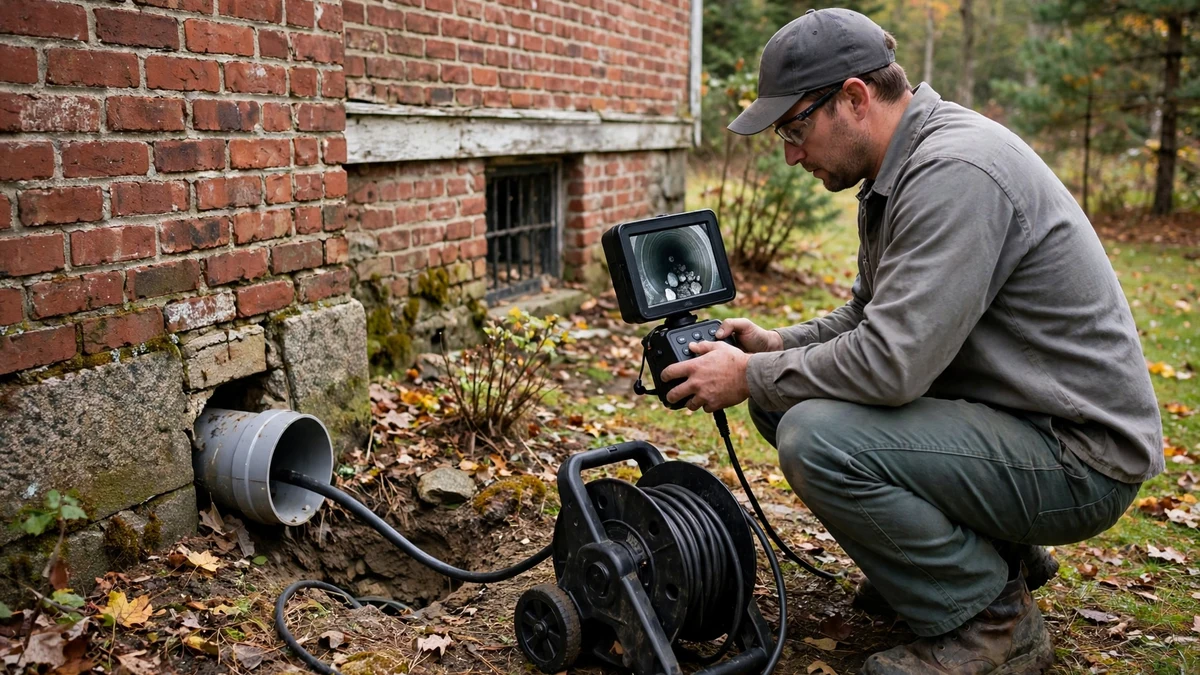
We work Augusta with a camera first, because a capital city holds a wider range of buildings than a typical town: single homes, multi-unit buildings, offices, and state-area properties, each with its own lateral layout. A slow drain in a downtown building and a backup on a Western Avenue street can share a symptom and hide different failures, and only footage separates a joint problem from a grease or scale problem.
Augusta Neighborhoods, ZIP Codes & Map
The ZIP codes and neighborhoods below are the Augusta areas we serve on public sewer. Tell us the neighborhood or ZIP code when you call, and the visit starts from the right part of the city.
ZIP codes we serve in Augusta:
ZIP code
Coverage
04330
Standard street-delivery ZIP
Post-office-box and single-organization ZIPs for Augusta are not listed, because they do not cover street addresses.
Neighborhoods we serve in Augusta:
Downtown AugustaSand HillCapitol AreaEast SideWest SideNorth Augusta
The map below centers on Augusta, Maine. Homes and buildings on public sewer in the neighborhoods above are within our service area. Larger buildings should mention the building type and affected floors when calling.
Primary ZIP: 04330. Our office address is 400 Congress St, Portland, ME 04101, United States, and you can reach us at (207) 819-0831 or [email protected].
Augusta Neighborhoods, Capitol to River to Corridors
Downtown Augusta and the Capitol Hill area hold the oldest core, where laterals run under old streets near the State House and the river. Sand Hill and the Cony area add residential streets with older homes, while Riverside Drive follows the Kennebec and its valley ground. Western Avenue, Eastern Avenue, and Manchester Road stretch the city outward, where newer homes and commercial streets bring a different pipe mix, including newer joints that can still fail singly.
Neighborhoods and areas we cover in Augusta include Downtown Augusta, Capitol Hill area, Sand Hill, Cony area, Riverside Drive area, Western Avenue area, Eastern Avenue area, Manchester Road area.
The Maine State House, with its dome above Capitol Hill, is the landmark Augusta is known by, and the Kennebec River is the second, running past downtown and shaping the valley. Fort Western, the old fort on the river, marks an even older layer of Augusta history. The City of Augusta site publishes city information for residents who want to learn more.
Capital Core Pipe and River Valley Ground in Augusta
Augusta's older core fails the familiar way: clay joints leak and admit roots, cast iron corrodes and narrows, and Orangeburg, where it survives, is past its roughly 50-year life. River valley ground adds a local accent, since damp valley soil heaves harder with freeze and thaw and works on joints in the downtown and Riverside areas. Newer corridor streets add the single-joint and settling pattern, where a new line can still fail at one seal or sag into a belly.
The symptom chain runs from condition to drain in the usual order: narrowing, slowing, gurgling, and then a backup that returns after clearing. In Augusta we also watch for a commercial pattern, where a building with high use shows grease or scale buildup in a line that is structurally sound. Jetting restores that line, while a structural failure needs a different tool, and the camera is what tells those two apart.
Maine frost depth commonly runs 4 to 5 feet or more, and Augusta's Kennebec Valley ground moves with freeze and thaw through every winter. Damp valley soil heaves harder than dry ground, and old joints in the downtown and Riverside areas feel that movement first. A line that slowed slightly last winter and a little more this winter is usually telling a structural story, not a blockage story.
We treat Augusta winter slowdowns as inspection prompts. Footage taken while the pattern is active shows frost effects clearly, and a planned warmer-month repair is easier ground work than an urgent winter dig. Capital-area properties with high winter use, from offices to multi-unit buildings, benefit most from an early camera check, since a planned repair avoids a mid-winter backup.
Augusta Signs That Point to the Line
Whole-building slow drains, gurgling fixtures, and backups that return after clearing point to the main line in Augusta. A sewage smell near a floor drain can mean a trap, vent, or joint issue, and we check those in turn. A single slow fixture usually means that fixture's branch, and we say so rather than recommending line work a property does not need.
Augusta building managers should mention which floors and fixtures are affected, because that pattern narrows the search in a larger building. A lowest-floor backup points downstream, toward the lateral or main, while a single-floor problem points to that floor's branch. That detail keeps the camera run focused and the repair correctly sized.
How We Work an Augusta Line
We follow a short, visible sequence in Augusta, for homes and larger buildings alike, so the repair is always tied to footage.
We record symptoms, building type, and affected floors, then locate the cleanout.
We run the camera to the main, noting joints, roots, bellies, grease, and material changes.
We explain the footage plainly and name the repair that fits it, from jetting to a spot repair, lining, or replacement.
We complete the repair and re-camera the finished line to confirm the result.
Augusta is a good place to see why lining, coating, and replacement are different tools. Lining forms a new structural pipe inside a host that still holds shape, coating seals a sound pipe that seeps at joints or pinholes, and replacement is the answer when the host has collapsed or lost grade. The camera shows which of those three fits a given Augusta line, and we explain the choice in plain words.
Sewer Services for Augusta Properties
Augusta's capital core and corridors need the full service range, from camera inspection downtown to commercial line work on the avenues. Each card below carries an Augusta note. The capital core pipe aging pattern is one we watch for here, and all work follows the Maine plumbing code and the Greater Augusta Utility District rules.
When a line breaks or sewage backs up and the house cannot wait, we stop the damage first and then trace the failure with a camera. That capital pattern is typical of Augusta, where an old downtown core and newer corridors share one city.
We run a push camera through the line and watch the footage with you, so the repair decision rests on what the pipe actually shows. In Augusta we see this from downtown and Capitol Hill out to Western Avenue, Eastern Avenue, and Riverside Drive.
Where the host pipe still holds its shape, we form a new pipe inside the old one through small access points, without a full trench. For an Augusta property, the footage decides, whether the building is a home or a larger property.
We pull a new HDPE pipe through the path of a failed line, breaking the old pipe outward as the new one takes its place. That capital pattern is typical of Augusta, where an old downtown core and newer corridors share one city.
When a line has collapsed or lost its grade, we open a trench, set the new pipe at the right fall, and backfill it properly. In Augusta we see this from downtown and Capitol Hill out to Western Avenue, Eastern Avenue, and Riverside Drive.
When the camera shows one bad joint or one cracked section, we fix that section only and leave the sound pipe alone. For an Augusta property, the footage decides, whether the building is a home or a larger property.
We replace the house-to-street segment when it has failed along its length, connecting the home cleanly to the main. That capital pattern is typical of Augusta, where an old downtown core and newer corridors share one city.
We scour grease, scale, and sludge from the pipe wall with high pressure water, restoring flow in a line that is still sound. In Augusta we see this from downtown and Capitol Hill out to Western Avenue, Eastern Avenue, and Riverside Drive.
We clear a blockage mechanically with a snake and cutter head, then check with a camera to see why it blocked. For an Augusta property, the footage decides, whether the building is a home or a larger property.
We cut roots out of the line at the joints where they entered, then camera-check the joint to judge what comes next. That capital pattern is typical of Augusta, where an old downtown core and newer corridors share one city.
We replace clay, cast iron, and Orangeburg runs that have reached the end of their working life with modern pipe. In Augusta we see this from downtown and Capitol Hill out to Western Avenue, Eastern Avenue, and Riverside Drive.
Where a pipe still has its strength but seeps at joints or pinholes, we coat its inside to seal it without replacing it. For an Augusta property, the footage decides, whether the building is a home or a larger property.
We inspect on a planned schedule, grade the condition over time, and catch joint wear or root regrowth while it is still small. That capital pattern is typical of Augusta, where an old downtown core and newer corridors share one city.
We fit a valve that closes when the street main surges, so a surge stops at the valve instead of coming up through the house drains. In Augusta we see this from downtown and Capitol Hill out to Western Avenue, Eastern Avenue, and Riverside Drive.
We trace a sewer smell to its source, checking traps, vents, seals, and the line itself with a camera before we recommend a fix. For an Augusta property, the footage decides, whether the building is a home or a larger property.
We handle shops, offices, and larger buildings, where high use and grease put a different load on the line than a house does. That capital pattern is typical of Augusta, where an old downtown core and newer corridors share one city.
Call or email about an Augusta property, and mention the building type and symptom pattern.
Augusta Repair Options, Compared Side by Side
Augusta lines run from an old capital core to newer streets, and the footage on each property decides the method.
Method
When it fits
What it avoids
Camera inspection
When the failure is suspected but not yet located
Repairing a section that may not be the problem
Spot repair
When one joint or section carries the whole failure
Replacing sound pipe alongside the bad section
Trenchless lining
When the pipe holds its shape and needs a new inner surface
A trench through a finished property
Full replacement
When the run has collapsed or failed in several places
Another temporary clearing
Frequently Asked Questions About Augusta Sewer Lines
Does Augusta have a public sewer system?
Yes. Augusta's core is served by a public sewer system, and the Greater Augusta Utility District serves the area. Homes on public sewer in the neighborhoods above are within our service area.
Why do Augusta downtown lines fail?
Downtown Augusta holds older homes and buildings with clay and cast iron laterals, and river valley ground that moves with freeze and thaw. Those two factors together work on joints.
Can you work on larger Augusta buildings?
Yes. We handle homes and larger buildings, and we ask about building type and affected floors so the inspection starts in the right place.
Which Augusta neighborhoods do you serve?
We serve downtown Augusta, the Capitol Hill area, Sand Hill, the Cony area, the Riverside Drive area, the Western Avenue area, the Eastern Avenue area, and the Manchester Road area.
What is the difference between lining and coating?
Lining forms a new structural pipe inside a host that still holds shape. Coating seals a sound pipe that seeps at joints or pinholes. The camera shows which fits a given line.
Should I camera-check an Augusta home before buying?
It is a sensible step for older Augusta homes, especially in the downtown core. A camera check shows lateral condition that a walk-through cannot.
Camera-Check Your Augusta Line
Tell us the neighborhood, the building type, and what the drains have been doing. We will inspect with a camera and explain the footage before any repair is discussed. In Augusta, that camera-first start is how every job begins.